Part 9 – Origins: Johann Fast and Judith Rempel
The Mennonite Settlers in Chortitza
Part 9 – Origins: Johann Fast and Judith Rempel
Copyright 2026 by Barry Teichroeb. All rights reserved. www.mooserungenealogy.com
Introduction
Johann Fast (1832-1885) and Judith Rempel (1832-) were second generation settlers of the Chortitza Mennonite Colony established in 1789 on the right bank of the Dnieper River in southern Ukraine. Johann’s parents arrived at the Chortitza settlement by way of Ekaterinoslav, the major city to the north, having lived there after emigrating from Prussia. Judith’s father was born in the Chortitza settlement, the son of earlier settlers, while her mother moved to the settlement from Prussia at the age of five. This article recounts the lives and origins of Johann and Judith. [Johann Fast (1852-1920), a son of Johann and Judith, is a second great grandfather of the author. His wife, Maria Krahn (1848-1916), a second great grandmother of the author, was the subject of Part 8 of this series.]
The Fast Family – The Fast Ancestors of Johann Fast (1832-1885)
Cornelius Fast (1722-1807) is the most distant Fast ancestor who can be associated with Johann Fast (1832-1885). It is uncertain where Cornelius was born but The Malbork Poland State Archives contain documents demonstrating that he lived in the village of Broeskerfeld in the Polish Lithuanian Commonwealth [1]. These documents tell us that his first wife was Catharina Warkentin (1725-1778) and his second wife was Anna Dyck. The same documents provide the names of his children. A Lutheran Church record referenced by the Grandma Database says that Cornelius died in Broeskerfeld in 1807 at the age of eighty-five [2]. An entry in the Ladekopp Mennonite Church registry records Catharina’s death in 1778 [3].
The Malbork Archives list the children of Cornelius and his first wife Catharina as Cornelius, Johann, Peter, Isaac, and Gerhard. The children of Cornelius and his second wife Anna are Anna, Claus, Abraham, Jacob, Anton, Catharina, and Justina.
One of the sons of Cornelius Fast (1722-1807) and Catharina Warkentin (1725-1778), also named Cornelius (1765-1825), immigrated to the Molotschna Mennonite settlement in 1821 with his wife, Maria Toews (1764-), and three children, Gertrude, Aganetha, and Cornelius. Their son Johann (1800-1841) did not travel with them. The family’s place of origin prior to emigrating was Wernersdorf, Prussia [4]. When they first arrived in the Molotschna area they lived in the village of Tiegerweide, but in 1824 they moved to Tiegenhagen. Cornelius died the next year leaving Maria and one of their adult children on the family homestead [5].
Johann Fast (1800-1841), the son of Cornelius Fast and Maria Toews, who did not emigrate with his family, moved to southern Ukraine at an unspecified date. Henry Schapansky has speculated that Johann lived at Ekaterinoslav, working as a miller, and later in the village of Einlage in the Chortitza Settlement [6]. Johann’s wife (she was also his cousin; see the following section about the Toews family), Aganetha Toews (1803-1865), lived in Ekaterinoslav as early as 1804 when her parents settled there [7]. Later there are references to a man named Johann Fast who acquired a lease for a distillery in the village of Einlage for the period 1839-1843 [8]. Authorities accused Johann of failing to pay taxes on the products he distilled and sold. After two years of bureaucratic wrangling authorities dropped the charges. In 1841, midway through the lease period, Johann died. It is not clear who operated the distillery through the end of the lease.
One of the sons of Johann Fast and Aganetha Toews was Jacob Fast (1822-1866). Helmut Huebert says Jacob operated a mill in the Chortitza settlement until his wife, Anna Heese, persuaded him to relocate to Ekaterinoslav and operate a mill there. It is possible that the mill Jacob operated in Ekaterinoslav was originally the treadmill operation established by his father. Around 1866, the year that Jacob died of Cholera, the family converted the mill to steam power. After Jacob’s death his wife Anna ran the mill with their son Heinrich. This mill remained in operation under the management of family descendants until 1911 [9].
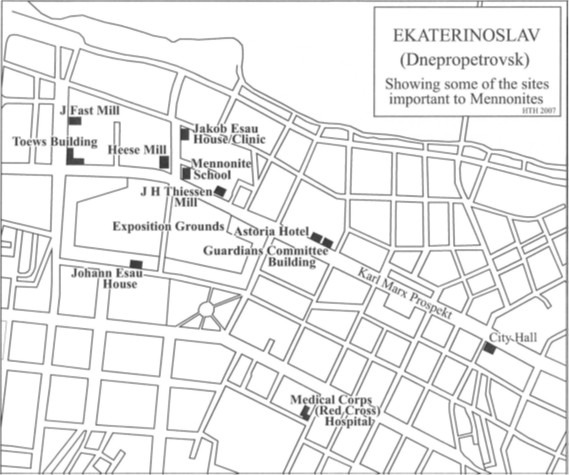
The following map of Ekaterinoslav refers to the Fast Mill [10]. This map also shows the location of the Toews Building, a property that had first belonged to the father of Agnetha Toews (1803-1865), and the Heese Mill, a property that belonged to the family of Anna Heese, Jacob Fast’s wife.
For more information about the business activities of the Fast, Heese, and Toews families see the article “The Fast – Toews – Heese Economic Dynasty 1765-1917” found at https://www.mooserungenealogy.com/articles/the-fast-toews-heese-economic-dynasty/.
Johann Fast (1832-1885), another son of Johann Fast (1800-1841) and Aganetha Toews (1803-1865), may have been born in the village of Chortitza [11] but spent his childhood in Einlage where his parents were distillers. As an adult, Johann settled in Rosenthal where he married Judith Rempel (1832-) around 1851 and where all of their children were born.
The first child of Johann and Judith was a boy named Johann (1852-1920). Johann (1852-1920) married Maria Krahn (1848-1916) in 1871. Maria Krahn was born in Rosenthal in 1848 to Cornelius Krahn (ca 1827-) and Helena Redekop (1822-1878). Johann and Maria remained in Rosenthal until the 1890s when they immigrated to Canada with their family of eight sons.
The second child of Johann and Judith was a girl named Maria (1858-1935). She married Wilhelm Heese, a son of the prominent Mennonite educator Heinrich Heese. Wilhelm was the half-brother of Anna Heese, the wife of Jacob Fast (1822-1866) who continued to operate the family mill business after her husband died [12].
The third child of Johann and Judith was Jacob (1860-1947). Jacob and his family endured a tumultuous life, surviving the chaos of Russia during World War I, followed by the Russian Civil War and the Ukrainian War of Independence, the property appropriations of the 1920s, the mass starvation and mass arrests of the 1930s and then World War II. The German army swept up Jacob and his family in the Nazi patriation of German-speaking residents of occupied Ukraine near the end of World War II [13]. Jacob’s family emigrated from Berlin to Canada in 1948, after his death [14].
The fourth child of Johann and Judith was Aganetha (1862-1909). She spent her entire life in Ukraine [15].
The fifth child of Johann and Judith was Heinrich (1871-1937). Heinrich emigrated in 1904, landing in Baltimore and then making his way to Saskatchewan to join his older brother, Johann (1852-1920) in Saskatchewan, where he worked as a carpenter [16].
The Toews Family – The Toews Ancestors of Johann Fast (1832-1885)
The mother of Johann Fast (1832-1885) was Aganetha Toews (1803-1862) who married Johann Fast (1800-1841) around 1821. Aganetha Toews was the daughter of Jacob Toews (1768-) and Aganetha Epp (1782-). According to Helmut T. Huebert, Jacob Toews was born in Warnau, a village about 4 km northwest of the city of Marienburg. His parents, Johann Toews (1743-1811) and Anna Stoesz (1730-1783) lived in Warnau until their deaths. Anna Stoesz was born in Gross Mausdorf, a village 13 km northeast of Marienburg [17]. Johann Toews was the son of Martin Toews (about 1720-1775) and Judith Suckau (about 1720- 1758), farmers in Warnau [18].
The mother of Johann Fast (1800-1841) was Maria Toews (1764-). Maria was the sister of Jacob Toews (1768-), making Johann (1800-1841) and his wife, Aganetha Toews (1803-1862), first cousins.
There is no known relationship between Aganetha’s mother, Aganetha Epp (1782-), and Elder Peter Epp (1725-1789). Peter Epp was the leader of the Flemish congregation in Danzig. Concerned about the erosion of Mennonite language, culture, and religion in the Prussian era after 1772, Peter Epp was a key leader and organizer in the Mennonite migration to the settlements in Ukraine that began in the years before his death [19].
The Jacob Toews family emigrated from Prussia to Ukraine in 1804 [20]. They were a wealthy family. Henry Schapansky has pointed out that the earliest settlers, who moved to Chortitza between 1789 and 1795, were usually not very well off. This was a product of the selection process for emigration because the Prussian authorities instituted a policy of restricting Mennonites with property from leaving Prussia. Later the Prussian crown relaxed the restrictions, with the consequence that more wealthy settlers began to arrive after about 1803 [21].
Jacob Toews (1768-) lived with his family in Ekaterinoslav. Detailed civic records provide information about his occupation and property ownership, demonstrating his relative wealth [22]. In 1805 he purchased property including a house and garden from a local resident. Later that year he filed a complaint about a theft of property at his house. A year later he filed another complaint, this time accusing soldiers from the local garrison of stealing property. That year he also requested a loan for economic purposes. One year later arsonists destroyed a Dutch windmill that Jacob owned. There had been one failed previous attempt that he complained about to the authorities. Three days later there was a repeated attempt that succeeded. The authorities issued an order to find the arsonists and to give assistance to Toews for his loss. The records are silent on results of the search for the culprits. In 1814 Jacob Toews leased a house to another city resident, indicating Toews had multiple properties in the city. In 1815 a customer lodged a complaint against Toews because Toews had milled barley for the customer and the customer alleged Toews did not return the milled grain as promised. The resolution of the situation is unknown.
In 1816 Toews requested a transfer to Molotschna. Authorities redirected him to Chortitza. It is unclear when the family moved to Chortitza, and whether the move occurred before or after Jacob’s daughter Aganetha (1803-1862) became married to Johann Fast (1800-1841).
The Rempel Family – The Ancestors of Judith Rempel (1832-)
The known ancestry of Judith Rempel (1832-), similar to her husband Johann Fast (1832-1885), traces back to the early eighteenth century.
Judith’s paternal grandparents were Dietrich Rempel (1763-1845) and Helena Wiebe (1772-1852). Both grandparents settled in Einlage in the Chortitza settlement in 1789, among the original group of 228 households who made the journey [23]. They arrived separately, Dietrich making the trip with his first wife, Judith Loewen, who died shortly after arriving, and Helena accompanying her parents. Dietrich’s parents, Isbrand Rempel (1737-1803) and Anna (1737-before 1801), had lived in Koenigsberg, the place where Dietrich was born [24]. However, by 1784 Dietrich lived in Stobbendorf, the location of his baptism that year. Stobbendorf is a village mid-way between Marienburg and Elbing [25]. Stobbendorf is also one of the villages where Helena Wiebe and her family lived before emigrating [26]. The Rempel family and the Wiebe family likely crossed paths in Stobbendorf and then again in Einlage. Dietrich and Helena were married in the village of Einlage in 1790. Their son Dietrich Rempel (1792-1843) was Judith Rempel’s father.
The parents of Helena Wiebe (1772-1852) were Heinrich Wiebe (1744-) and Helena Goossen (1744-1815). They settled originally in the village of Einlage in the Chortitza settlement but later moved to Rosenthal [27]. Helena Goossen’s father was Heinrich Goossen. He lived in Altendorf, near Marienburg. He did not emigrate.
Judith’s maternal grandparents were Johann Nickel (1746-before 1806) and Anna Nickel (1749-). Johann’s father was Peter Nickel and Anna’s father was Jacob Nickel [28]. There is no indication that Johann and Anna were related. The couple was married around 1764 after which they lived in Truel, a village in the Schwetz Lowlands of the Vistula River near the city of Graudenz. The Schwetz Lowlands are a swampy region where, as happened frequently when the Dutch Mennonites moved to the Polish Lithuanian Commonwealth in the sixteenth century, the settlers worked to reclaim fertile farmland and build Mennonite settlements. Johann and Anna were members of the Frisian Church congregation.
Johann Nickel (1746-before 1806) and Anna Nickel (1749-) moved to Chortitza in 1793 [29], and settled in Kronsgarten, a village established in 1794. Kronsgarten was unique among Chortitza villages because the majority of the settlers were members of the Frisian church congregation, unlike the settlers in other villages who were from Flemish congregations [30]. Their daughter, Maria Nickel (1792-1863) married Dietrich Rempel (1792-1843) in 1815 in the village of Rosenthal [31].
In 1832 Maria Nickel and Dietrich Rempel had a daughter named Judith (1832-). Around 1851 Judith married a local man, Johann Fast (1832-1885) in Rosenthal and they lived there for the remainder of their lives.
Source Notes
[1] Broeske Grundbuch Page 299, State Archives of Malbork, Poland, Fond 342, File 128. Found at: https://mla.bethelks.edu/archives/VI_53/Malbork/Broeske/Broeske%20I%20Grundbuch%20Malbork%20Archives%20Fond%20341%20File%20128/.
[2] The Grandma Database is located at https://grandmaonline.org. Cornelius Fast (1722-1807) is #480974.
[3] https://mgr.mennonitegenealogy.com/prussia/, Ladekopp Church Records. Found at: https://mla.bethelks.edu/archives/cong_306/18-19.jpg.

[4] Peter Rempel, Mennonite Migration to Russia 1788-1828, Winnipeg, Manitoba Mennonite Historical Society, 2000, p. 179.
[5] Glenn Penner, Molotschna Mennonite Settlement Revision List for 1835 Found at: https://mgr.mennonitegenealogy.com/russia/Molotschna_Mennonite_Settlement_Census_1835.pdf, Tiegenhagen #17.
[6] Henry Schapansky, Mennonite Migrations and The Old Colony, Russia (Rosenort, Henry Schapansky, 2006), p. 383.
[7] Peter Rempel, p. 89.
[8] Glenn Penner, “Alcohol Production in the Chortitza and Bergthal Colonies”, Preservings Fall 2021 No. 43, Winnipeg, Plett Foundation, University of Winnipeg, pp. 21-28.
[9] Helmut T. Huebert, Mennonites in the Cities of Imperial Russia Volume 2, Winnipeg, Springfield Publishers, 2008, pp. 92, 93, 104.
[10] Helmut T. Huebert, p. 95.
[11] Berlin Document Center A3342 EWZ50 [Folder B055, frame 1154] found at https://grandmaonline.org/TEMP/B055-1154.pdf.
[12] Helmut T. Huebert, p. 108.
[13] Berlin Document Center A3342 EWZ50 [Folder B055, frame 1154] found at https://grandmaonline.org/TEMP/B055-1154.pdf.
[14] More information about the family and the tragic events in Canada can be read in this article: “The Search for the Ancestors of Johann Fast (1852-1920)” found at https://www.mooserungenealogy.com/articles/the-search-for-the-ancestors-of-johann-fast-1852-1920/.
[15] Berlin Document Center A3342 EWZ50 [Folder E005, frame 1098] found at https://grandmaonline.org/TEMP/E005-1098.pdf.
[16] Baltimore, Maryland, U.S., Passenger Lists, 1820-1964 found at https://www.ancestry.ca/imageviewer/collections/8679/images/mdt844_43-0300?rc=&usePUB=true&_phsrc=LfW16&_phstart=successSource&pId=581986.
[17] Helmut T. Huebert, pp. 122-123.
[18] Ulrich Dueck, Ulrich Dueck West Prussian Genealogy Charts, found at https://mla.bethelks.edu/metadata/ms_482.php, p. 101.
[19] More information about Peter Epp and his efforts to protect the Dutch Mennonite cultural legacy can be read in the article “Eastern Vision - The Peter Epp Story (1725-1789)” found at https://www.mooserungenealogy.com/articles/eastern-vision-the-peter-epp-story/.
[20] Peter Rempel, p. 89.
[21] Henry Schapansky, pp. 199, 383.
[22] Helmut T. Huebert, p.122. The author derived additional details in this passage not recorded by Huebert from State Archives Dnipropetrovsk Region, “Office of Guardianship for Foreign Settlers in New Russia" (Fond 134). Tim Janzen provided this information, in association with Grandma Database project.
[23] Glenn H. Penner, The First Mennonite Settlers in the Chortitza Settlement, found at https://mgr.mennonitegenealogy.com/russia/First_Mennonite_Settlers_in_Chortitza.pdf.
[24] Henry Schapansky, p. 402.
[25] Adalbert Goertz, Mennonite Baptisms in Tiegenhagen, West Prussia: 1782-1800 found at https://www.mennonitegenealogy.com/prussia/Tiegenhagen_Baptisms_1782-1800.htm.
[26] Henry Schapansky, p. 405.
[27] This statement is based on Chortitza census records that can be found at https://mgr.mennonitegenealogy.com/russia/.
[28] Henry Schapansky, p. 664.
[29] Peter Rempel, p. 20. Note that the immigration date of 1793 is uncertain and the family may have arrived later.
[30] Bergen, Heinz. "Kronsgarten (Chortitza Mennonite Settlement, Dnipropetrovsk Oblast, Ukraine)." Global Anabaptist Mennonite Encyclopedia Online. June 2013. Found at https://gameo.org/index.php?title=Kronsgarten_(Chortitza_Mennonite_Settlement,_Dnipropetrovsk_Oblast,_Ukraine)&oldid=166224.
[31] This marriage date is from information in the Grandma Database, located at https://grandmaonline.org. Dietrich Rempel (1792-1843) is #198161.
Post a comment